tiistai 10. tammikuuta 2017

January in the Heart of Winter

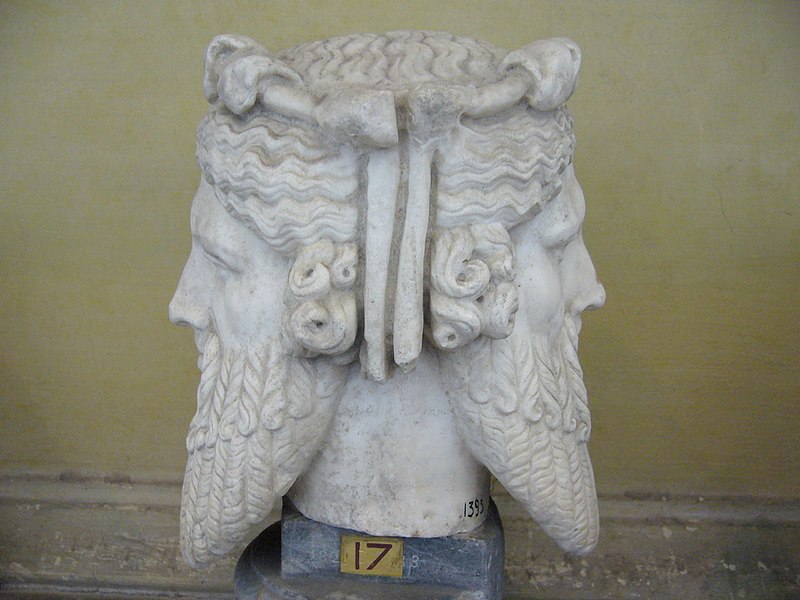
Janus looks simultaneously into the past and future.
Image source: Wikimedia
I was going to introduce this month earlier, but now that my schedule plans have failed, I'll just say that better late than never.

The latin name of the month, januarius, means a month that is dedicated to god Janus. Janus was a two-faced god of beginnings, gates and front doors. January is the first month of the year because of the Romans: it was officially set as the beginning of the year by Julius Caesar a little before the start of Christian era. This practice spread around Europe with the church.

For a long time in Finland the changing of the year was celebrated in late autumn, when year's hard farm work was done and the winter season started. In the kingdom of Sweden the year was started from Christmas until the mid-16th century, when the financial year was set to start from January 1st. In these northern conditions the 1st of January isn't especially logical time to start a new year.

The world tree of Finnish mythology is a big oak.
Maybe it also was the center of the world?
Image source: Kamera mukaan blog
The Finnish word for January is tammikuu. Word "tammi" is most commonly known as meaning "oak". However, in this case the word has a different meaning. It's still used in some dialects to mean something that is in the center, like an axle. January has also been called sydänkuu, "heart month". This word works in English as well: heart is in the middle of something, and January is in the heart of winter.

People felt that January was the second coldest month. February was even colder, although also sunnier. January was thought to be the kinder of these two months. According to one story February says to January: "if I was in your place I would freeze a foal into its mother's womb and servant's nails into a dough bowl, but I can't because the sun shines into my eyes".

The heart of winter was a difficult time. The weather was harsh. One saying suggests that freezing temperatures would change into a blizzard, only to change back to cold weather again. In work calendar this meant time for rest, but on the other hand it was believed that everything acquired in this month was strong and durable. A tree that was felled in January wouldn't rot or get worms. In Karelia the thread used for fishing nets was spun in January so they wouldn't break in use. The heart of winter was also good time for getting rid of bedbugs.

In modern times January is a time of new beginnings. Fiscal year still starts from 1st of January. Many people start a new hobby to get rid of weight gained during Christmas season or to put into effect a New Year's resolution. After the alcohol consumption that is part of many Christmas and New Year's parties lots of people drop alcohol completely for January.

In a modern person's comfy life getting through the winter is no longer a big challenge. Still at least I wait eagerly that I see the days getting gradually longer. In January or February there is a point when "winter's back breaks". But more about that in another post.

Sydänkuu

Janus katsoo menneeseen ja tulevaisuuteen.
Kuvan lähde: Wikimedia
Minun oli tarkoitus esitellä kuukausi heti kuun alussa, mutta kun aikataulut pettivät niin todettakoon vain, että parempi myöhään kuin ei milloinkaan.

Suomen talvi päivästä päivään -kirja kertoo tammikuun latinankielisen nimen, januarius, tarkoittavan Janus-jumalalle pyhitettyä kuukautta. Kaksikasvoinen Janus oli alkamisen, porttien ja ulko-ovien jumala. Tammikuun paikka vuoden ensimmäisenä kuukautena tuleekin antiikin Roomasta: sen virallisti Julius Caesar hieman ennen ajanlaskun alkua. Se levisi laajempaan käyttöön kirkon myötä.

Suomessa vuoden vaihtumista juhlittiin pitkään myöhäissyksyllä, kun syksyn työt oli saatu tehdyksi ja talvikausi alkoi. Ruotsin valtakunnassa vuosi alkoi jouluna 1500-luvun puoliväliin saakka, jolloin tammikuun ensimmäinen virallistettiin tilivuoden alkamispäiväksi. Suomen olosuhteissa tammikuun ensimmäinen ei olekaan erityisen looginen paikka vuoden vaihtumiselle.

Kalevalassakin esiintyvä maailmanpuu on tammi.
Se kaiketi oli myös maailman keskellä, akselina?
Kuvan lähde: Kamera mukaan -blogi
Sana tammi ei tässä yhteydessä viittaa puuhun vaan jonkin keskellä olevaan asiaan. Vilkuna kertoo, että hämäläismurteissa tammi tarkoittaa "napaa, akselia ja keskipuuta". Tammikuun toinen nimi, sydänkuu, kuulostaa muidenkin murteiden puhujien korvaan selkeästi keskuskuukaudelta. Tammikuu on se aika, joka on talven keskellä, sydäntalvi.

Kansan kokemuksen mukaan tammikuu on vuoden toiseksi kylmin kuukausi. Helmikuu, eli pikkutammi tai toinen sydänkuu, on vielä kylmempi, vaikkakin aurinkoisempi. Vilkuna kertoo, että isotammea, eli tammikuuta, on pidetty hyväntahtoisempana kuin pikkutammea. Nivalasta poimitun kertomuksen mukaan pikkutammi sanoo isolletammelle: "Jos olisin sinun sijassasi, niin palelluttaisin varsan emänsä mahaan ja piian kynnet taikinapurtiloon, mutta en pysty, kun päivä huikaisee silmät."

Sydäntalvi oli rankkaa aikaa. Vilkuna mainitsee pessimistisen sanonnan "Pakkanen pyryn perästä, pahailma pakkasesta." Töiden osalta tämä tarkoitti toisaalta talvilevon aikaa, muta toisaalta kaikki sydänkuilla hankittu oli lujaa ja riittävää. Uskottiin, ettei tammikuussa kaadettu puu lahoa eikä siihen tule toukkia. Karjalan kannaksella kehrättiin verkkolangat tammikuussa, jotta niistä tulisi kestäviä. Tammikuussa oli sopivaa aikaa myös syöpäläisten hävittämiseen.

Nykyään tammikuu on uuden alun aikaa. Tilivuosi alkaa edelleen tammikuun ensimmäisestä. Monet aloittavat uuden liikuntaharrastuksen joulukilojen karistamiseksi tai uudenvuodenlupausten täyttämiseksi. Pikkujoulukauden ja uudenvuoden juhlimisen jälkeen tipaton tammikuu on muodostunut yleisesti tunnetuksi käsitteeksi.

Modernin ihmisen mukavassa elämässä talvesta selviäminen ei ole enää suuri haaste, mutta silti  ainakin minä odotan joka vuosi pikkuhiljaa piteneviä päiviä. Tammi-helmikuulle osuukin hetki, jolloin sanotaan että talvenselkä katkeaa. Mutta siitä lisää toisella kertaa.

lauantai 7. tammikuuta 2017

The end of Christmas

All the great celebrations of winter seem to be a complex set of varying traditions. Let's start with Epiphany, the last of the holy days related to Christmas, celebrated on January 6th.

"Adoration of the Magi with Saint Anthony Abbot"
Source: Wikimedia

The Finnish word for Epiphany, "loppiainen", refers to something ending. It's the day when Christmas season ends. Epiphany is a very old feast day, and it's changed its meaning during the history. Before the day of celebrating Jesus's birth was set to its current place in 350's, it was celebrated on Epiphany. In the third century it was not only a celebration for Jesus's birth, but also for his baptism and for his first public miracle. The word epiphany refers to revelation of the Lord, and all these events are related to that.

Nowadays in the church year the baptism and the first miracle of Jesus are remembered on the first and second Sunday after Epiphany, respectively. Epiphany itself has become the day of the three Magi. In the fourth century the Magi, also known as the Three Kings or Wise Men, were thought to represent the three continents that were the known world for Christians at the time.Thus the Magi represented all the people of the world kneeling in front of Jesus. Through this metaphor Epiphany also became the day of missionary work.

After Epiphany comes Nuutti, a well-known day for Finns because of the saying "Good Tuomas brings Christmas, bad Nuutti takes it away". Before 18th century Nuutti's nameday was on January 7th, but since 1708 it has been on 13th of January. So which one is the day when Christmas ends?

According to Kustaa Vilkuna it can be either. The latter date is an "after feast" of Epiphany. Vilkuna says that every major religious holiday needed an after feast. Nuutti has also marked the end of "Christmas peace", a time when punishments for crimes was harder than usual. Christmas peace was known already in medieval times, and according to different sources it lasted for either 13 or 20 days. That means it has ended either on Epiphany or on the newer Nuutti's day. Vilkuna reminds us that the Christmas celebrations didn't necessarily need to end at the same time even in the same village. The richer population could have celebrated for a week longer than the poor people.

Nuuttipukki on the year 1973.
Source; SKS
An important tradition for ending Christmas season was the so-called nuuttipukki, literally "Nuutti goat". A few young people dressed up in funny clothes and travelled from house to house to empty the beer barrels. As the group advanced on its journey it also grew as people from visited houses joined them. The leader of the group, nuuttipukki, would smell if the house still had some beer left and the crowd would ask for the family to give them the beer. If they got what they asked they would thank the house with a song. If they were denied they would also sing, this time a rude song with crude language. The food and drinks that were gathered weren't necessarily consumed there and then, but instead was loaded into a sleigh and taken to the largest house in the village. There the last Christmas dance was held and the last beer and food was drunk and eaten together.

Vilkuna says that the nuuttipukki tradition was strong until the wars in 1940's withered it away. But according to SKS website this tradition is still alive and well in some parts of the country. Even I know some people who have dressed up as a nuuttipukki as a child.

In any case Epiphany and Nuutti's day still mark the end of Christmas season. Many people take out the Christmas tree and pack away the Christmas decorations on January 6th, or at the latest on January 13th. The last bits of Christmas ham have been used in pea soup and the chocolates have been finally eaten. After several weeks of celebrations returning to regular schedule is starting to feel like a good thing.

Joulun lopettajaiset

Talven suuret juhlat tuntuvat olevan varsin monimutkainen perinteiden soppa. Aloitetaan joulun viimeisestä kirkollisesta pyhästä loppiaisesta, jota juhlitaan 6.1.

"Adoration of the Magi with Saint Anthony Abbot".
Lähde: Wikimedia

Reijo Ylimyksen Pyhän vuoden pyhät -kirja kertoo loppiais-sanan tarkoittavan loppupäivää, sitä päivää jolloin joulun pyhät päättyvät. Loppiainen on hyvin vanha juhla, joka on muuttanut ja täydentänyt sisältöään useita kertoja. Ennen kuin Jeesuksen syntymäjuhla vakiinnutettiin nykyiselle paikalleen 350-luvulla, loppiainen toimitti joulun virkaa. Se oli 200-luvulla Jeesuksen syntymän, mutta myös hänen kasteensa ja julkisen esiintymisensä juhla. Loppiaisen toinen nimi, epifania, viittaa Herran ilmestymiseen, mihin nämä kaikki tapahtumat linkittyvät. Ylimys sanoo Jordanin kasteen ja Kaanaan häiden ihmeen istuvan hyvin juhlan epifania-luonteeseen, sillä "Herran ilmestyminen oli aistihavainnoin koettavissa".

Nykyään Jeesuksen kastetta ja Kaanaan häiden ihmettä muistellaan kirkkovuodessa ensimmäisenä ja toisena sunnuntaina loppiaisesta. Loppiaisesta on sen sijaan tullut Itämaan tietäjien muistopäivä. Kolme viisasta miestä, maagia tai kuningasta pidettiin 300-luvulta lähtien silloin tunnettujen maanosien edustajina. Näin tietäjät edustivat kaikkia maailman kansoja, jotka kumartuivat Jeesuksen eteen. Samalla heidän mukanaan loppiaisesta tuli lähetystyön pyhä.

Loppiaista seuraa Nuutin päivä, joka oli ennen 1700-lukua 7.1., mutta vuodesta 1708 lähtien 13.1. Kun sanotaan, että paha Nuutti vie joulun, niin kumpaa päivää tarkoitetaan?

Vilkunan Vuotuisen ajantiedon mukaan voidaan tarkoittaa kumpaakin. Jälkimmäinen päivämäärä edustaa epifanian jälkipyhää, "jollainen piti olla jokaisella huomattavalla kirkkojuhlalla". Nuuttiin on loppunut myös joulurauha, joka on eri keskiaikaisten lähteiden mukaan kestänyt joko 13 tai 20 päivää, ja on siis loppunut joko loppiaiseen tai uudempaan Nuutin päivään. Vilkuna huomauttaa, ettei joulun juhlinnan ole tarvinnut loppua samana päivänä edes samassa kylässä: rikkaampi väki on voinut juhlia viikon kauemmin kuin köyhempi väestö.

Nuuttipukki vuodelta 1973.
Lähde: SKS
Joulun lopettajaisten keskeinen perinne oli nuuttipukit. Muutaman hassunkurisesti pukeutuneen miehen tai naisen joukko lähti kiertämään talosta taloon saadakseen oluttynnyrit tyhjiksi koko kylästä. Kiertueen edetessä myös joukko kasvoi. Joukon johtaja, nuuttipukki (tai -akka tai -parooni), haisteli löytyykö talosta olutta, ja seurue huusi "Olvitapit auki". Jos olutta saatiin, seurasi kaunis kiitoslaulu. Kieltäytymistä seurasi karkeasanainen haukkumalaulu. Tarjoiluja ei välttämättä tarjoiltu paikan päällä, vaan ne koottiin rekeen, ja kuljetettiin sillä kylän suurimpaan tupaan. Siellä pidettiin joulun viimeiset tanssit, ja nautittiin yhteisesti viimeiset herkut.

Vilkunan mukaan nuuttipukkiperinne eli vahvana aina 30-luvulle saakka, kunnes sotavuosien myötä tapa hiipui. Kuitenkin SKS:n tietopaketin mukaan pienet ja suuret nuuttipukit kulkevat edelleen etenkin Satakunnassa ja Hämeessä, ja minunkin lähipiiristäni löytyy ihmisiä jotka muistavat itse pukeutuneensa nuuttipukeiksi.

Joka tapauksessa loppiainen ja nuutinpäivä pysyvät edelleen joulun loppumisen päivinä. Monet vievät kuusen ulos ja keräävät joulukoristeet laatikkoon loppiaisena, tai jos ei vielä silloin niin kuitenkin 13.1. Nuutinpäivään mennessä. Kinkunjämät on pilkottu hernekeittoon ja viimeisetkin konvehtirasiat syöty. Monen viikon juhlimisen jälkeen paluu arkeen alkaa olla jo ihan tervetullut juttu.